Independent MapQuest feature guide
MapQuest Gas Calculator: Estimate Fuel Cost for a Trip
MapQuest Gas Calculator is a practical search for anyone who wants to understand the fuel budget of a route before leaving. A credible estimate combines route distance, the vehicle’s real fuel economy, the current price assumption, and the way the trip will actually be driven. This independent guide explains the calculation, the inputs that can distort it, and ways to make the result useful for a commute, road trip, or multi-stop day. Third-party tools and labels may change, so confirm current MapQuest functionality and local fuel prices separately rather than treating one displayed number as a guarantee. Review the MapQuest Gas Calculator details before you choose a route.

- Core formula
- Estimated miles divided by real miles per gallon, multiplied by price
- Best input
- Your vehicle’s recent fuel economy, not only its brochure figure
- Add margin for
- Traffic, idling, hills, weather, cargo, detours, and local driving
- Verify separately
- Current pump price, fuel availability, and vehicle requirements
What a MapQuest Gas Calculator estimate can tell you
A fuel calculator turns a route distance into an approximate fuel budget. The basic relationship is simple: divide the expected miles by the vehicle’s miles per gallon, then multiply the gallons by the price per gallon. The value is not an exact bill. It is a planning number that helps compare a commute, choose a stop, or decide whether a long detour fits the trip budget. Showing the assumptions is more useful than presenting a precise-looking total without context. For background, read Gas Calculator on Wikipedia when you need context beyond this planning guide.
Start by deciding which distance belongs in the estimate. A one-way route, a round trip, a route with errands, and a route with a scenic detour are different calculations. Include the miles you expect to drive after reaching the destination if you will visit several locations locally. If the route depends on a ferry, mountain pass, border crossing, or event traffic, allow for the possibility that the final mileage changes. A clean estimate begins with a clearly defined journey.
Gather the three essential fuel inputs
Use a route distance from the actual trip, then choose a fuel-economy figure that reflects the vehicle’s current use. A dashboard average from recent mixed driving may be more honest than a laboratory rating, especially if the journey includes city traffic, a roof rack, a trailer, passengers, cold weather, or steep grades. For a rental or unfamiliar vehicle, create a range rather than pretending you know one exact number. The low and high cases make the uncertainty visible. For broader route planning, visit MapQuest Driving Directions on the homepage after reviewing this MapQuest Gas Calculator guide.
The price assumption should also be transparent. Fuel prices vary by state, neighborhood, highway exit, brand, taxes, and time of day. Use a current local observation or a conservative planning price, and mark the date or location attached to that assumption. If the route crosses regions with different prices, a single average may be adequate for a rough budget but not for deciding where to refuel. The calculator can do arithmetic; you supply the context that makes the arithmetic credible.
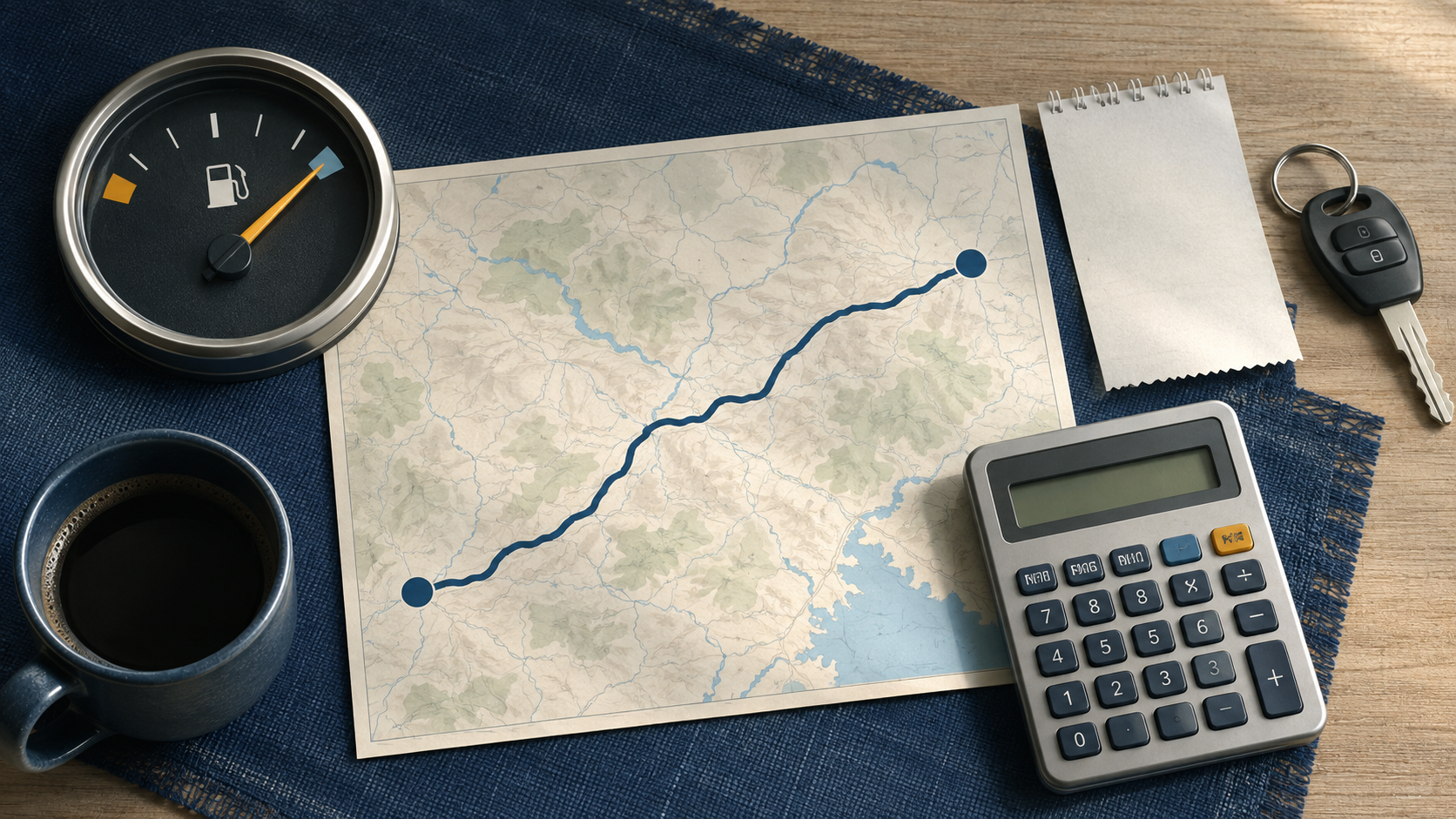
A step-by-step gas cost calculation
First, identify the route miles and decide whether they represent one direction or the full trip. Next, divide those miles by the vehicle’s realistic miles-per-gallon estimate to find approximate gallons used. Finally, multiply the gallons by the selected fuel price. If you expect a detour or local driving, add those miles before calculating. If you want a cautious budget, run the calculation twice with a lower and higher efficiency assumption rather than adding an unexplained percentage to the final answer.
For example, a route of 420 miles in a vehicle averaging 28 miles per gallon would use about 15 gallons before conditions are considered. A price assumption can then convert those gallons into a rough cost. The example is a method, not a quote for a current journey. Recalculate when the route, vehicle, fuel price, or number of stops changes. Small input changes matter more on long trips, so preserve the assumptions with the result in a note or itinerary.
Why real driving can exceed the estimate
The route distance does not capture every source of fuel use. Stop-and-go traffic, long idling, repeated cold starts, strong wind, snow tires, heavy cargo, air-conditioning demand, hills, and higher speeds can all reduce economy. A trip that looks like one smooth highway run may include urban approaches, queues, construction, and parking-lot circulation. Consider using a range of expected efficiency for a route with unusual conditions, and add a small distance allowance for the local travel that happens after arrival.
Fuel planning should include the vehicle’s operating needs as well. Some vehicles require a particular fuel grade, have a smaller usable range than the dashboard suggests, or need charging and fueling stops planned together. Do not run the tank close to empty simply because a calculator says the miles fit. Weather, station closures, payment problems, and unexpected detours can remove the margin. A safe plan protects a reserve and identifies a practical stop before the gauge becomes urgent.
- Separate one-way, round-trip, and multi-stop mileage.
- Use recent vehicle efficiency and create a range for unfamiliar conditions.
- Date or locate the fuel-price assumption so the estimate can be refreshed.
- Include a reserve for traffic, detours, weather, and station availability.
Using the result for a commute or road trip
For a commute, compare the fuel estimate for different weekly patterns rather than judging one drive in isolation. A slightly longer route may use less fuel if it avoids repeated congestion, but a highway route may be more efficient when traffic is light. Track real fill-ups over several weeks if you need a dependable household budget. The calculator then becomes a check against observed use instead of a substitute for it.
For a road trip, pair the fuel estimate with planned stops, lodging, food, tolls, parking, and vehicle charging or maintenance. Decide in advance which stops are flexible and which are needed for range or safety. Share the route assumptions with other travelers so everyone understands why the budget may change. Keep the estimate available offline, but make adjustments only while parked and use current local signs and station information on the road.
How to use this MapQuest Gas Calculator planning guide
- Define the trip distance as one-way, round trip, or a multi-stop total.
- Choose a realistic fuel-economy figure from recent driving or a conservative range.
- Use a current or deliberately conservative fuel-price assumption and record its location.
- Divide miles by miles per gallon to estimate gallons, then multiply by price.
- Add a margin for traffic, weather, cargo, detours, and local driving after arrival.
- Plan a safe refueling point and never treat the estimate as permission to run empty.
Questions about MapQuest Gas Calculator
How does a MapQuest Gas Calculator estimate trip cost?
The usual method divides estimated route miles by realistic miles per gallon and multiplies the result by an assumed fuel price. The output is approximate and should be adjusted for detours, traffic, vehicle load, and changing local prices.
Should I use my vehicle’s advertised MPG?
Use recent real-world fuel economy when possible. Advertised figures may not match a trip with heavy cargo, hills, cold weather, stop-and-go traffic, towing, or high speeds, so a range is often safer for planning.
Does the gas estimate include local driving?
Only if you include those miles. Add errands, hotel-to-attraction trips, parking circulation, and any expected detours before calculating the fuel budget.
How much fuel reserve should I plan?
There is no universal reserve that fits every vehicle or route. Keep a comfortable margin for weather, closures, traffic, and unexpected detours, and follow the vehicle manufacturer’s guidance rather than driving until the gauge is nearly empty.